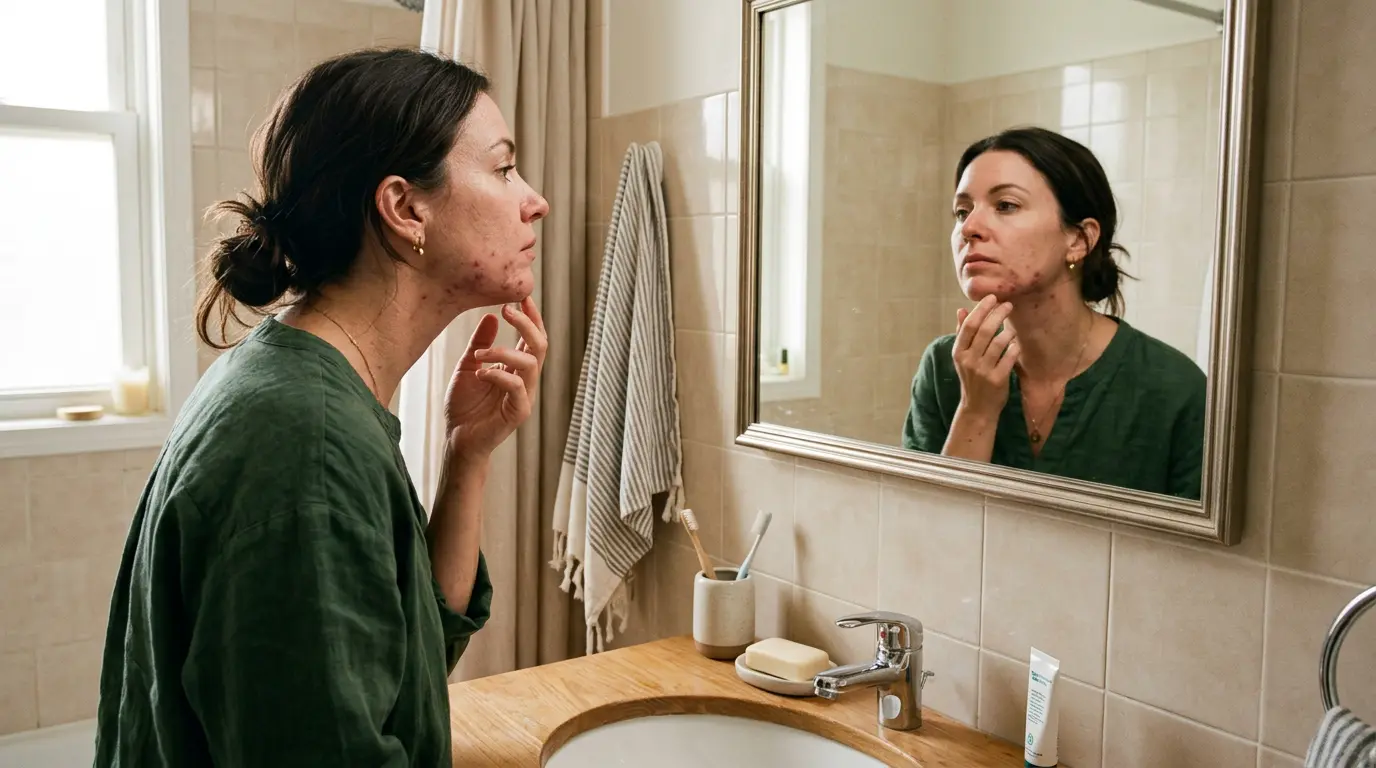
You did everything right. Your skin cleared up in your 20s. You found a routine that worked. Then somewhere in your late 30s, a deep, painful cyst showed up along your jaw. Then another. And the spots those left behind? Tucson's sun made them darker every week.
If that sounds familiar, I wrote this for you. I'm going to walk you through how to identify the different types of acne and what causes each one, so you're not treating the wrong problem. I'll cover the six main acne types, the three root causes, what perimenopause does to your skin, why dark spots stick around longer in the Arizona heat, and when a skin consultation is the right first step.
Not sure where to start? Book a skin consultation with me and I'll look at what's actually happening before recommending anything.
What Are the Different Types of Acne — and How Do You Spot Them?
Acne falls into two categories: non-inflammatory and inflammatory. Non-inflammatory stays close to the surface and is easier to treat. Inflammatory acne goes deeper and needs a completely different approach.
Non-Inflammatory Acne:
- Whiteheads — Closed, flesh-colored bump. The pore is fully clogged with no air exposure.
- Blackheads — Open pore with a dark surface. The color comes from oxidation, not dirt.
Inflammatory Acne:
- Papules — Small, red, tender bumps with no pus. Do not squeeze these.
- Pustules — White or yellow center with a red base. The classic pimple most people recognize.
- Nodules — Deep, hard, painful lumps with no visible head. These sit well below the skin surface.
- Cysts — Deep, pus-filled, the most painful type and the highest risk for permanent scarring.
Nodules and cysts need the most attention. Squeezing them almost always makes things worse and raises your risk of permanent scarring and dark spots.
I tell clients this all the time: treating cystic acne the same as a surface pustule is the most common mistake I see walk through my door. They need completely different approaches, and the wrong one can make the damage last for years.
What Actually Causes Acne? (It's Not Just "Dirty Skin")
Three things drive every type of acne: excess oil production, dead skin cell buildup in the pore, and bacterial activity from Cutibacterium acnes (also known as P. acnes). Hormones control oil production, which is why breakouts spike during hormonal shifts.
Washing your face more often doesn't fix any of those three things. It can strip your skin barrier and actually make breakouts worse. I see this constantly with new clients who've been scrubbing harder and wondering why nothing is getting better.
In Tucson, there's a fourth factor: our desert climate. Dry heat pushes skin to overproduce oil to compensate for moisture loss. A lot of my clients try to fix that dryness by layering on heavier moisturizers, which ends up clogging pores instead. Desert skin needs balance, not more product.
Research on the skin microbiome also suggests that prebiotics and probiotics in skincare may help manage acne-prone skin. I can walk you through whether those options make sense for your skin during a consultation.
Why Are Women in Their 30s and 40s Breaking Out Again?
According to research published in the National Library of Medicine, roughly 25% of women in their 40s experience acne, even if their skin was clear for years before it returned. You're not imagining it. Your hormones are shifting.
During perimenopause, estrogen and progesterone both decline. Progesterone normally calms oil glands. When it drops, oil production shifts to androgen control. Testosterone declines more slowly than estrogen, which creates a period where androgens are relatively dominant. That's what triggers the deep, cystic breakouts concentrated along the jaw and chin.
This type of acne won't respond to the products you used at 16. The root cause is different. Hormonal shifts from stress, HRT, PCOS, and postpartum periods follow the same mechanism and produce the same kind of breakouts.
And perimenopause can start in your mid-30s, not just your mid-40s. That's earlier than most women expect — and earlier than most skincare content talks about.
If your skin is changing and you're not sure what's behind it, my facials for acne-prone skin start with a full skin assessment so we figure it out together.
What Is Post-Inflammatory Hyperpigmentation — and Why Does Arizona Sun Make It Worse?
Post-inflammatory hyperpigmentation (PIH) is the dark spot that lingers after an acne lesion heals. It's not a scar. It's excess melanin your skin produced in response to the inflammation. The pimple clears, but the mark stays.
In Tucson, this is a bigger problem than in most parts of the country. Arizona's UV exposure is not your friend when it comes to PIH. UV radiation darkens existing spots and extends the healing timeline. Without daily sun protection, acne-related marks can take years to fade. One study found that daily use of SPF 30-60 for eight weeks led to 81% of patients noticing lightening of their hyperpigmented marks. The clients using SPF 60 saw more improvement than those using SPF 30.
The order matters. Clear the active acne first, then address the PIH. Trying to treat both at once without guidance often inflames things further. Cystic acne carries the highest PIH risk, which makes managing it early especially important here in Arizona.
When Is Acne Something a Facial Can Help — and When Do You Need a Dermatologist?
I'll be honest with you about this — because I think it matters.
I can help with identifying your acne type and likely triggers, mild to moderate hormonal acne, bacterial acne, PIH treatment, skin barrier repair, and product selection including prebiotics and probiotic-based options.
A dermatologist is the right call for severe cystic acne that hasn't responded to any topical approach, acne that may need cortisone injections or prescription medication, and anything that could point to an underlying condition like PCOS.
The gray zone is more common than you'd think. A skin consultation helps figure out which category you're in. That's faster than spending months on products that aren't built for your type of acne.
My job isn't to treat every skin condition. It's to give you an honest picture and a real plan. If you need a dermatologist, I'll tell you that directly.
What Happens at an Acne Skin Consultation?
The consultation starts with a skin assessment. I look at your acne type, where it's concentrated, how long it's been happening, and what your current routine includes. Then we talk through triggers: hormones, diet, the products you're using, and how Tucson's dry heat and UV exposure may be affecting your skin specifically.
You'll leave knowing what type of acne you have and what's likely causing it. Not with a bag of products and a guess.
My consultation fee applies to your first service or product purchase. No-risk way to get real answers about what's going on with your skin.
Book Your Acne Skin Consultation
Still not sure what type of acne you're dealing with? Start with a consultation. Your fee applies toward your first treatment or product purchase. Real answers about your skin, no obligation.